
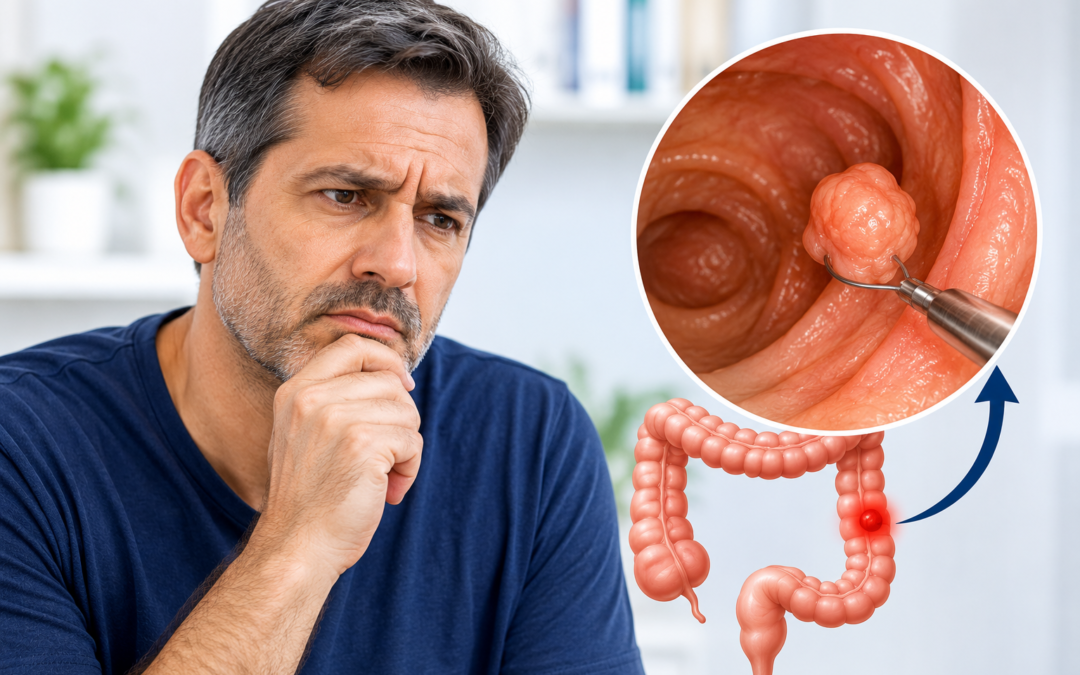
Most colon polyps never turn into cancer. Only certain types, mainly adenomas and some serrated polyps, can change over time. That change is slow, usually around 10 years and sometimes up to 15. The risk goes up when a polyp is larger than 1 cm, has villous growth, or shows high-grade dysplasia. A polyp that is removed early can’t become cancer, which is why a colonoscopy is as much about prevention as detection.
According to Dr. Sandeep Nayak, a Colorectal Surgeon in Bangalore, “Hearing that you have a polyp can be frightening, but it’s often good news in disguise. A polyp found and removed during a colonoscopy is a cancer that never got the chance to form. What I’d ask patients to remember is that these growths rarely cause symptoms, so waiting for a warning sign means you may wait too long. Screening is what makes the difference.”
Wondering if your colon polyps could turn into cancer? Get expert guidance on screening and removal.
Which colon polyps can turn into cancer
- Adenomas. These are the classic precancerous polyps, and most colon cancers begin in one of them.
- Serrated polyps. Sessile serrated polyps, especially in the upper (right) colon, can also progress and are treated with the same seriousness as advanced adenomas.
- Hyperplastic and inflammatory polyps. These rarely become cancer, although a doctor still needs to confirm the type under a microscope.
- Advanced features. A size of 10 mm or more, villous growth or high-grade dysplasia puts a polyp in the higher-risk group.
Spotting these features early is the whole point of screening, and techniques for surgery for complex polyps and early cancers allow even difficult polyps to be dealt with before they cause harm.
How long it takes and what raises the risk
- The timeline. Estimates suggest roughly 10 years for a polyp to progress to cancer, which gives a wide window to catch it.
- Size matters. The bigger the polyp, the higher the chance that cancer cells are hiding in it, especially beyond 1 cm.
- Number of polyps. Having several adenomas, particularly three or more, raises the chance of future polyps and cancer.
- Personal background. A family history of colorectal cancer, long-standing inflammatory bowel disease and increasing age all push the risk up.
If a close relative has had polyps or bowel cancer, it’s worth reading about hereditary and family risk and when to begin screening earlier than usual.
What Determines the Right Treatment for Colon Polyps?
- Size and shape. Small polyps and those on a stalk are usually removed whole during colonoscopy, while large flat ones may need advanced endoscopic or surgical techniques.
- Pathology report. The lab result shows the polyp type and grade of dysplasia, and it sets the follow-up schedule.
- Location in the bowel. A polyp’s position affects how safely and completely it can be removed.
- Signs of cancer inside the polyp. If cancer cells have grown deeper into the wall, further tests or surgery may be needed, and the schedule for repeat colonoscopy depends on what was found.
FAQ
Are all colon polyps cancerous?
No. Most are harmless. Adenomas and some serrated polyps are considered precancerous, which is why doctors remove them rather than watch them.
Can a polyp turn into cancer in a year?
It’s unlikely. The change usually takes many years, although a large or advanced polyp can progress faster than a small one.
Do colon polyps cause symptoms?
Often they don’t. Larger ones may cause bleeding in the stool, a change in bowel habits or low haemoglobin, but many are found only during screening.
Can polyps come back after removal?
The removed polyp won’t return, but new ones can form. That’s why your doctor will advise a repeat colonoscopy after a set interval.
Reference
- NCBI / PubMed Central. Colon adenoma features and risk of future colonic neoplasia (review). https://pmc.ncbi.nlm.nih.gov/articles/PMC5156849
- NCBI / PubMed Central. A pooled analysis of advanced colorectal neoplasia diagnoses following colonoscopic polypectomy. https://pmc.ncbi.nlm.nih.gov/articles/PMC3685417
Disclaimer
This article is for general education and does not replace advice from a qualified doctor. Survival figures are averages and cannot predict an individual’s outcome. Please consult a specialist for diagnosis and treatment.