
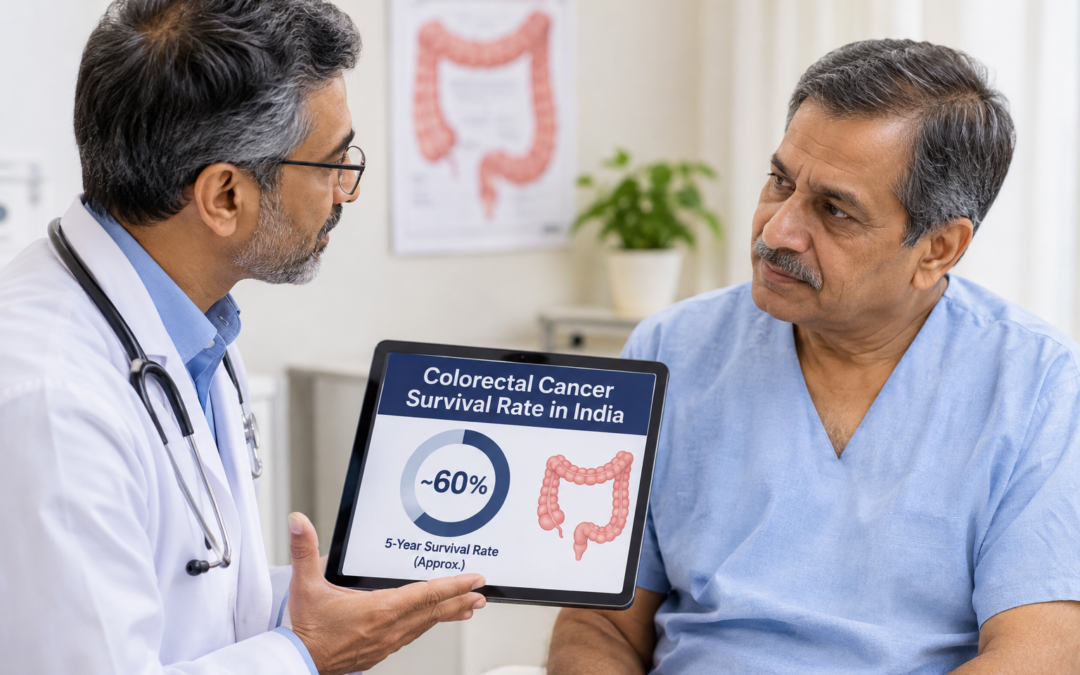
Studies of Indian patients have reported five-year net survival of roughly 34% for colon cancer and 38% for rectal cancer. That is well below the 60–65% seen in countries like the US and England. The colorectal cancer survival rate in India isn’t one fixed number, though. It changes sharply with the stage at diagnosis, and when the disease is caught early, results at good Indian centres can be very different from these national averages.
According to Dr. Sandeep Nayak, a Colorectal Surgeon in Bangalore, “A survival figure is an average, and it can’t tell you what will happen to one person. What I see in clinic is that the stage at which a patient first walks in matters most. If the cancer is found early, surgery alone can often be enough, and the outlook is very good. When bleeding or a change in bowel habit is ignored for months, the choices become fewer. So please don’t wait.”
Worried about the colorectal cancer survival rate in India and what it means for you? Speak to a specialist today
Colorectal cancer survival rate in India by stage
- Early (localised) cancer. When the tumour hasn’t spread beyond the bowel wall, five-year survival is around 90% in large international datasets.
- Regional spread. If nearby lymph nodes are involved, survival comes down to roughly 70–75%, and chemotherapy usually joins surgery.
- Distant spread. Once cancer reaches organs like the liver or lungs, five-year survival is much lower, around 13–18% in US data, though treatment can still control the disease for years in some patients.
- An Indian example. In a Tata Memorial Hospital study of colon cancer, five-year survival was 89% for early disease and 43% for advanced disease.
The pattern is clear: finding the cancer sooner changes the odds more than anything else, and options like surgery for complex polyps and early cancers exist precisely for that early window.
How India's survival numbers compare with other countries
- Indian national estimates. Five-year net survival was reported at about 34% for colon and 38% for rectal cancer in data from 2008–12.
- Developed countries. Five-year relative survival is about 65% in the US and about 58% in England in recent periods.
- Better-resourced Indian centres. The Mumbai colon cancer study mentioned above found a five-year overall survival of 71%, showing what’s possible with timely, structured care.
- Where care is harder to reach. A study from Himachal Pradesh found most patients arrived at stage 3 or 4, and many dropped out of follow-up. Only 23 of 165 patients were alive at 60 months.
These gaps come from late detection and uneven access, and the same cancer treated at the right time and in the right place can have a very different story, which is why it helps to look at colorectal cancer treatment options early on.
What Determines the Colorectal Cancer Survival Rate in India for an Individual Patient?
- Stage at diagnosis. It is the single biggest factor, and in the Himachal study it was the only one that significantly changed overall survival.
- Completing the full treatment plan. Surgery, chemotherapy or radiation only work when they’re finished on schedule, and many patients drop out because of distance, cost or fear.
- Tumour site and biology. Colon and rectal cancers behave differently, and genetic testing can open up targeted or immunotherapy options.
- Overall health and follow-up. Age, other illnesses and regular surveillance after treatment all help catch a return of the disease early.
FAQ
What is the 5-year survival rate of colorectal cancer in India?
Published Indian estimates are around 34% for colon cancer and 38% for rectal cancer. Individual hospitals often report higher figures, especially when most patients come in at an early stage.
Is early-stage colorectal cancer curable?
In many cases, yes. When the cancer is confined to the bowel wall, five-year survival is about 90%, and surgery is often the main treatment.
Why is the survival rate lower in India than in the West?
Mostly because more patients are diagnosed late, screening isn’t widely available, and access to complete treatment varies. The disease itself isn’t necessarily more aggressive.
Does a survival rate predict my own outcome?
No. These numbers are group averages from past patients. Your stage, tumour type, health and treatment plan decide your own outlook, and your doctor can give a far more accurate picture.
Reference
- National Cancer Institute, SEER. Cancer Stat Facts: Colorectal Cancer. https://seer.cancer.gov/statfacts/html/colorect.html
- NCBI / PubMed Central. Clinical and treatment profile with five-year survival analysis of colorectal cancer from a Himalayan state of India (ecancermedicalscience, 2025). https://www.ncbi.nlm.nih.gov/pmc/articles/PMC12812816/
Disclaimer
This article is for general education and does not replace advice from a qualified doctor. Survival figures are averages and cannot predict an individual’s outcome. Please consult a specialist for diagnosis and treatment.