
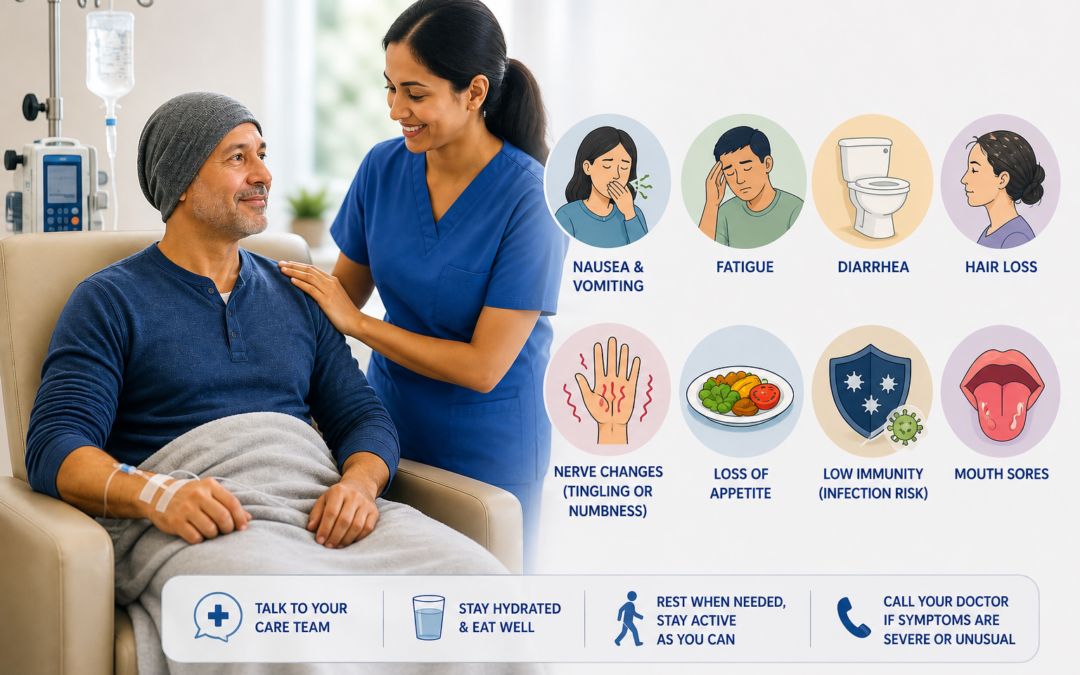
Ask ten people on the same chemo how their week went and you’ll get ten different answers. Even so, the usual complaints are a fairly short list: exhaustion, a stomach that won’t settle, loose motions, and blood counts that drop. Hair thins but mostly stays. Each drug then adds something of its own. Oxaliplatin can make your fingers buzz the second you touch something cold, and capecitabine tends to leave the palms and soles red and tender.
According to Dr. Sandeep Nayak, rectal cancer surgery, “early mobilisation after resection, even within 24 hours of the procedure, significantly reduces the risk of post-operative complications including deep vein thrombosis and ileus.”
Starting chemo soon? Get a written list of side effects, and who to call, before your first cycle.
Side Effects of Colon Cancer Chemotherapy You Might Run Into
What you get depends on the drugs, the doses and, honestly, a bit of luck with how your own body copes. Some people barely notice the first few cycles. Others feel flattened straight away. Here’s what turns up most often:
- Tiredness, nausea, no appetite. Exhaustion is the one nearly everyone mentions, and it doesn’t always lift between cycles. Eat little and often, and try a short walk even when you don’t feel like it. Our page on nutrition and activity after surgery has more ideas you can use.
- Diarrhoea and mouth sores. Loose stools can dry you out sooner than you’d think, so keep sipping fluids, and tell your team if it keeps going. Mouth sores are common too. Other everyday questions are answered in our colon cancer FAQs.
- Low blood counts. The drugs knock down your white cells, red cells and platelets, so infections come easier, tiredness gets worse and you may bruise. Blood is checked before every cycle. More on this in chemotherapy and targeted therapy for colorectal cancer.
- Thinner hair and odd tastes. With FOLFOX and CAPOX, hair usually thins and doesn’t fall out completely. Food may taste metallic or bland for a while. For the wider picture, see our colon cancer treatment overview.
What Determines the Right Treatment Approach for Colon Cancer Chemotherapy?
There’s no single regimen for everyone, and the likely side effects are part of how it’s chosen. Your team will weigh up:
- Stage and risk of the cancer returning. Chemo is often recommended for higher-risk stage II and for stage III. Your stage of colon cancer helps decide whether you need it.
- Which regimen, and for how long. FOLFOX, CAPOX and capecitabine on its own each have their own pattern of side effects. For some people, a shorter course is safe.
- What the tumour tests show. In some cases, biomarker results steer treatment towards targeted drugs or immunotherapy.
- How well you are overall, and what you want. Age matters less than heart, kidney and liver health, other illnesses, and your own goals. If advanced disease has reached the abdominal lining, cytoreductive surgery and HIPEC may be talked about too.
Key Takeaways
- Which side effects you get depends on the drugs, so ask what goes with your regimen.
- Fatigue, nausea, loose stools and low blood counts are the usual four.
- Oxaliplatin tingling is set off by cold and builds up over cycles. Capecitabine can leave hands and feet sore and red.
- A fever of 38°C (100.4°F) or more in the middle of chemo means a same-day call.
- Don’t sit on symptoms. A dose tweak or a simple medicine often fixes more than people expect.
FAQ
Will I lose all my hair on colon cancer chemo?
Most likely not. FOLFOX and CAPOX usually thin it out. Other regimens, such as FOLFIRI, are more likely to cause proper hair loss. Your own oncologist can say what’s likely on your regimen.
How long will the side effects go on for?
Mostly a few days up to a couple of weeks after each cycle. Tiredness can go on for months. The tingling from oxaliplatin can last longer, and for some people it doesn’t fully clear.
Can anything be done to reduce them?
Yes, a fair bit. There are tablets for sickness and for diarrhoea, creams and habits that protect hands and feet, and your dose can be adjusted. The catch is that your team can’t fix what they don’t know about, so say something about every new symptom.
When should I head to the hospital during chemo?
Don’t wait for the next appointment if you have a fever of 38°C (100.4°F) or above, chest pain, confusion, severe stomach pain, or diarrhoea that keeps going. Go straight in.
Reference
Disclaimer
This article is for general information only and doesn’t replace medical advice, diagnosis or treatment. Side effects and regimens differ from one person to the next. Please talk to your own oncology team about what applies to you.