
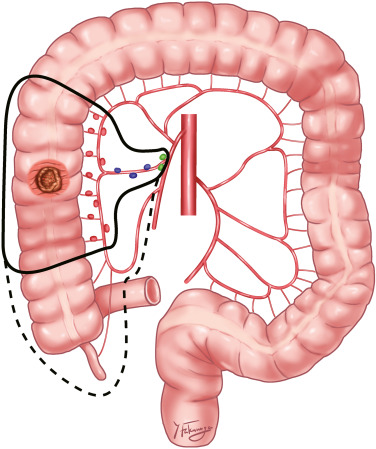
When colon cancer surgery is being planned, one of the most important decisions a surgeon makes has nothing to do with the tumour itself it has to do with how many lymph nodes are removed along with it. This is where the terms D2 and D3 lymph node dissection come in. Both describe how far the dissection extends beyond the tumour, and the difference between them can meaningfully affect how much information is gained about the cancer’s spread, and how it is treated afterward.
According to Dr. Sandeep Nayak, colorectal cancer surgeon, “The extent of lymph node dissection is not a technical detail buried in the operating room. It is one of the clearest predictors of how accurately we can stage a patient’s cancer, and increasingly, of how well they do in the years after surgery.”
Unsure which extent of dissection applies to your case?
What Actually Separates D2 from D3 Dissection?
The difference comes down to how far the surgeon follows the blood vessels feeding the tumour, and how many stations of lymph nodes are cleared along the way.
- What D2 removes D2 dissection clears the lymph nodes sitting close to the colon wall and along the intermediate portion of the feeding blood vessels, covering the two nodal stations nearest the tumour.
- What D3 removes D3 dissection goes a step further, clearing the central lymph nodes located at the very root of the feeding artery, where it branches off the main mesenteric vessel — the station furthest from the tumour and closest to the body’s central lymphatic pathways.
- Why the extra distance matters Central nodes are where cancer cells travel to once they’ve moved past the nodes nearer the tumour, so removing them gives a more complete picture of whether the disease has spread further than initially suspected.
- What this means for staging Because D3 dissection typically yields a higher number of lymph nodes for pathology to examine, it reduces the chance of understaging a patient whose cancer has, in fact, already reached the central nodes.
- The trade-off involved D3 dissection is technically more demanding and carries a modestly higher risk of complications such as chyle leakage, which is why it is generally reserved for cases where the added thoroughness is likely to change the outcome.
For a closer look at how this fits into the broader operation, our D3 dissection page walks through how the procedure is performed and who it is typically recommended for.
Does the Extent of Dissection Actually Change Outcomes?
This is the question that has driven most of the research comparing the two approaches, and the evidence has been building steadily in one direction.
- Disease-free survival Several studies following patients with stage II and III right-sided colon cancer have found meaningfully higher five-year disease-free survival in patients who underwent D3 dissection compared to D2.
- Recurrence rates Lower recurrence has also been reported after D3 dissection in more advanced cases, consistent with the idea that clearing central nodes catches disease that D2 dissection would leave behind.
- Where the benefit is less clear In earlier-stage disease, some studies have found no significant difference in outcomes between D2 and D3, suggesting the benefit is not uniform across every patient.
- What this means in practice The choice between D2 and D3 is not one-size-fits-all; it is shaped by the stage of disease, the location of the tumour, and the individual patient’s risk profile, which is why this decision is made case by case rather than as a fixed rule.
This is part of the same broader picture we explored in our colon vs rectal comparison, where the extent and type of surgery is shown to depend heavily on exactly where a tumour sits and how it behaves.
Why Choose Dr. Sandeep Nayak for Colon Cancer Surgery?
Dr. Sandeep Nayak has over 20 years of experience performing colon and rectal cancer surgery across major Bangalore hospitals, leading Surgical Oncology and Robotic Surgery at multiple centres. He trains colorectal surgeons across India in advanced lymph node dissection techniques, including D3 lymphadenectomy, and tailors the extent of dissection to each patient’s stage and risk profile rather than applying a single approach across the board.
Patients are guided through exactly why a particular extent of dissection is recommended for their case, so the decision never feels like a technicality happening somewhere out of view.
Call +91 9482202240 to book your consultation.
FAQ
Is D3 dissection always better than D2?
Not necessarily. D3 shows a clearer survival benefit in more advanced disease, while earlier-stage cases may not show a significant difference between the two.
Does D3 dissection carry more risk than D2?
D3 is technically more demanding and has a slightly higher rate of certain complications like chyle leakage, though overall complication rates are broadly similar between the two.
How does the extent of dissection affect cancer staging?
D3 dissection typically retrieves more lymph nodes for examination, which lowers the chance of missing disease that has already reached the central nodes.
Who decides whether D2 or D3 dissection is appropriate?
The surgeon makes this decision based on the tumour’s location, stage, and the patient’s individual risk factors, generally as part of a broader treatment discussion.
Reference
Disclaimer
This blog is intended for informational and educational purposes only. It does not constitute medical advice. Please consult a qualified medical professional for diagnosis and treatment guidance.