
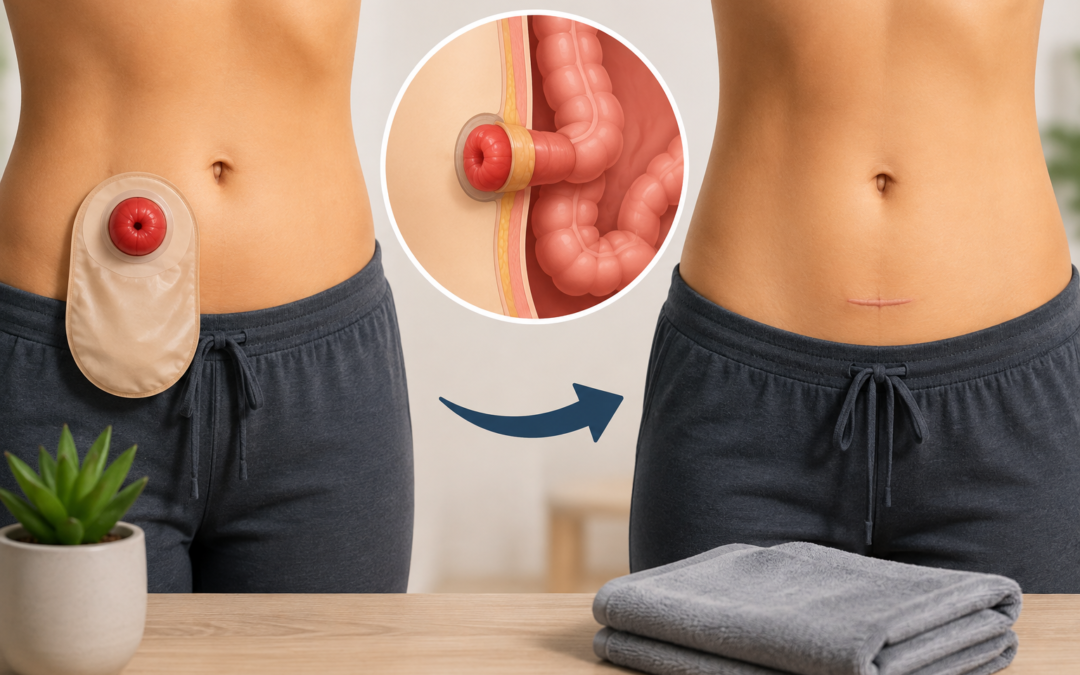
A stoma is a surgically created opening on the abdominal wall that allows waste to exit into an external pouch instead of through the rectum. It is most commonly needed after colorectal cancer surgery, inflammatory bowel disease, or trauma, and can be temporary or permanent. When created as a protective diversion, reversal is possible in most cases.
According to Dr. Sandeep Nayak, colorectal cancer surgery today prioritises stoma avoidance wherever oncologically safe, and when a temporary stoma is created, most patients are suitable candidates for reversal within three to six months.
Worried about whether your stoma can be reversed after surgery?
What Are the Different Types of Stoma?
Stoma type determines function, location on the abdomen, and whether reversal is technically straightforward or complex.
- Colostomy: This involves bringing part of the colon to the abdominal surface and is most often created after surgery for sigmoid or rectal cancer, producing formed stool output that many patients find easier to manage than other stoma types.
- Ileostomy: Created from the small intestine rather than the colon, an ileostomy produces liquid output continuously because it bypasses the large bowel where water absorption normally occurs, requiring careful fluid and electrolyte management.
- Loop stoma: A loop of bowel is brought through the abdominal wall and opened on both sides, creating a temporary diversion that’s quicker to form and generally simpler to reverse, often used to protect a fresh bowel join after rectal surgery.
- End stoma: The bowel is fully divided and one end is brought to the surface while the other is either removed or closed internally. Reversal is still possible in many cases but involves a more involved reconnection procedure than a loop stoma.
Not every stoma type carries the same reversal complexity, and a surgeon’s assessment of bowel length, sphincter function, and anastomotic integrity all factor into the decision.Learn more about laparoscopic colon surgery.
When Can a Stoma Be Reversed and What Does Recovery Look Like?
Reversal timing depends on healing of the original bowel join, the patient’s overall condition, and whether any additional treatment like chemotherapy is still ongoing.
- Timing: Most temporary stomas created to protect a low rectal anastomosis are reversed between 8 and 12 weeks after the original surgery, though patients receiving adjuvant chemotherapy may wait six months or longer before reversal is considered.
- Pre-reversal assessment: Before closure, surgeons confirm the downstream bowel join has healed fully using a contrast enema or flexible endoscopy, because reversing a stoma over an intact but incompletely healed anastomosis carries real risk of leak.
- The reversal procedure: Stoma reversal is typically a shorter operation than the original surgery, often taking 45 to 90 minutes, and most patients are admitted for two to four days depending on how quickly normal bowel function returns.
- Bowel function after reversal: It’s normal for bowel habits to be unpredictable for several weeks after stoma closure, with frequent loose motions initially, and most patients find function settles progressively over three to six months as the bowel adapts.
Permanent stomas, while life-changing, don’t prevent patients from living full and active lives, and specialist stoma nurses provide ongoing support from the day of surgery.For related reading, see rectal cancer cured without stoma.
Why Choose Dr. Sandeep Nayak for Colorectal Cancer Surgery?
Dr. Sandeep Nayak is one of India’s leading colorectal surgeons with over 20 years of experience in robotic and laparoscopic bowel surgery. His practice at KIMS Hospitals and MACS Clinic has a strong focus on sphincter preservation and stoma avoidance, meaning patients who were told elsewhere they’d need a permanent stoma have often left his operating theatre without one.
Where a stoma is unavoidable, his team plans reversal from the outset and supports patients through every stage of adjustment and recovery. Outcomes here aren’t measured in completed operations but in what patients can do six months after leaving hospital.
FAQ
How long does a temporary stoma last?
Most temporary stomas are reversed within 3 to 6 months of the original surgery.
Is stoma reversal a major operation?
It’s a shorter procedure than the original surgery, usually requiring 2 to 4 days in hospital.
Can all stomas be reversed?
No. Permanent stomas, such as after abdominoperineal resection, can’t be reversed.
Will bowel function return to normal after reversal?
Most patients see gradual improvement over 3 to 6 months as bowel function settles.
Reference
Disclaimer
This blog is intended for informational and educational purposes only. It does not constitute medical advice. Please consult a qualified medical professional for diagnosis and treatment guidance.